


Bacteria
Analyse bacterial DNA, including organisms that are difficult to cultivate.


Investigate samples for the presence of bacteria, DNA viruses, fungi and parasites in one culture-independent analysis. MBioSEQ™ DISQVER is a bioinformatics platform for the metagenomic analysis of microbial cell-free DNA directly from blood.
For research use only. Not for diagnostic use.
microbial references searched1
including 1,500+ pathogens1
analysis after sample receipt1
Shipping time is additional.
blood sample as starting material
Confirm collection requirements.
01 / The approach
Culture-independent explorationWhen a predefined target panel is too narrow for your research question, a search across a microbial reference database offers a broader starting point. MBioSEQ™ DISQVER investigates cell-free DNA2 without the need of multiplying the target organisms by culture.
For teams investigating microbial DNA in blood, the question is not only which organisms to look for, but how to interpret the findings. Explore the result view below and the published research to assess whether this approach fits your investigation.
A broad search has defined limits: RNA viruses are not covered, and database coverage does not guarantee detection in every sample. For Research Use Only. Not for use in clinical diagnostic procedures.
Analyse bacterial DNA, including organisms that are difficult to cultivate.
Explore DNA viruses alongside other microbial groups. RNA viruses are not covered.
Bring fungal DNA into the same analysis, beyond bacterial targets.
Extend your view to parasite DNA represented in the reference database.
02 / The process
From biology to bioinformaticsThe starting point
Begin with blood as the source of microbial cell-free DNA. Agree collection and transport requirements with the team before arranging samples for your research.
Discuss your research
Blood sample
Microbial cell-free DNA
The molecular signal
Next-generation sequencing reads DNA fragments extracted from the sample, creating the sequence data needed for microbial analysis.
Discuss your research
Next-generation sequencing
From fragments to data
The comparison
MBioSEQ™ DISQVER’s proprietary bioinformatics compares sequencing data against a curated microbial reference database to analyse the organisms represented in the sample.
Discuss your research
Bioinformatic analysis
Microbial reference database
The interpretation
A structured report brings the microbial findings together for research interpretation. Explore the results in the context of your investigation.
Explore the evidence
Structured reporting
Information in context
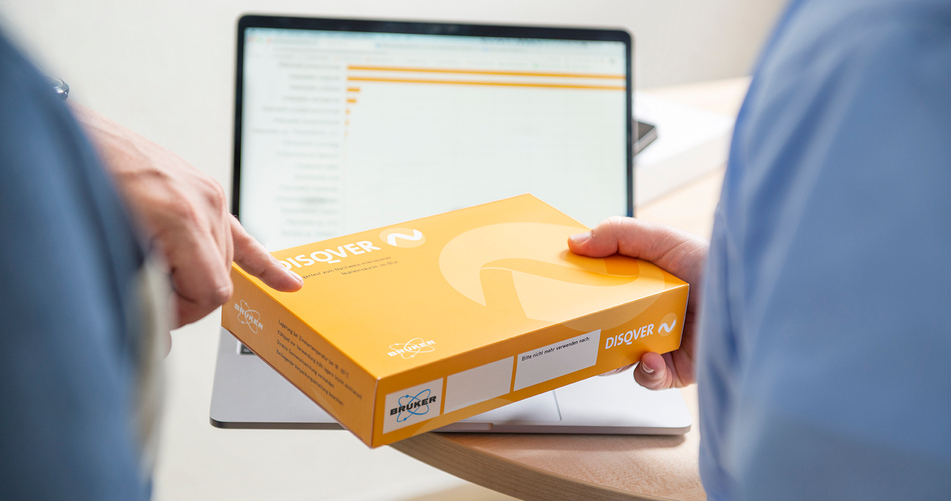
The platform & output
From sequence data to microbial findings, MBioSEQ™ DISQVER brings bioinformatics and reporting together.1 Explore three fictional examples to see how different organism groups, taxonomic families and read counts can be presented for review.
Discuss workflow & reporting
Different findings. One structured view.
Fictional demonstration data · Not patient results or a performance benchmarkBacterial, fungal and DNA viral entries sit alongside each other. Grouping keeps the different organisms readable without turning the list into a clinical conclusion.
Several organism entries do not establish several active infections. Each finding needs context.
One organism, its taxonomic family and its read count appear together. Only the Bacteria group is shown because it is the only group with a finding.
With only one finding, the relevance bar fills the full width. This is a relative display, not 100% certainty.
All three examples use fictional findings, read counts and relevance bar lengths. Orange bars show relative statistical relevance within each report; grey badges show reads separately. A full bar is not a probability or a measure of infection severity. Statistical relevance does not establish clinical significance. For Research Use Only. Not for use in clinical diagnostic procedures.
Names and taxonomic families are grouped by organism type.
Switch between one bacterial entry, two DNA viruses and findings across three groups. Only groups with findings appear; relevance bars are relative within each report, not a shared scale across reports.
DNA detection alone does not establish an active infection. This
example illustrates presentation; confirm the current report
format with the team.
A negative result does not exclude every organism.
03 / Research
Peer-reviewed perspectivesBrowse research in sepsis, intensive care, clinical microbiology, neonatology and haematology. Study design and limitations matter when assessing relevance to your research.
Selected original research · Clinical study settings are described below. These publications do not change the current research-use-only status of MBioSEQ™ DISQVER.
DigiSep · Brenner et al. · Intensive Care Medicine
389 patients across 24 ICUs. The primary DOOR/RADAR endpoint was not significantly improved. Secondary analyses suggested benefits, but are exploratory and require confirmation.
Read publication (opens in a new tab)
2026
Schroeder et al. · Journal of Clinical Medicine
393 paired samples from 302 ICU patients. Bacterial mNGS positivity was similar with and without ongoing antibiotics, while blood culture positivity was lower during treatment. Observational findings do not establish improved outcomes.
Read publication (opens in a new tab)
2025
Esse et al. · Clinical Microbiology and Infection
An evaluation of mcfDNA analysis in patients with suspected infections. Read the original article for performance measures, assessment of therapeutic impact and the limits of the clinical setting.
Read publication (opens in a new tab)
2025
Neidhöfer et al. · Frontiers in Cellular and Infection Microbiology
A single-centre analysis reported value for rare and non-culturable organisms, alongside interpretation challenges for microbiota-associated findings. Results depend on the study setting.
Read publication (opens in a new tab)
2024
Balks et al. · Pediatric Research · Published online 2024
Explored DISQVER® alongside blood cultures in neonates. Sample exclusions, false-negative findings and interpretation challenges limit generalisation; this was a feasibility study.
Read publication (opens in a new tab)
2022
Schulz et al. · Open Forum Infectious Diseases
Investigated metagenomic pathogen detection during neutropenic fever. A defined haematological population provides a specific research context, rather than evidence for every patient group.
Read publication (opens in a new tab)

Additional publications from the Noscendo bibliography, plus the ADNEMIA protocol. This collection includes cohort studies, case reports, protocols and earlier method research; these have different levels of evidence and do not all evaluate the current platform.
Protocol only; not a report of outcome results.
04 / News & updates
Developments from MBioSEQ™ DISQVER and Bruker.
Bruker has announced the acquisition of the DISQVER platform from Noscendo. MBioSEQ™ DISQVER remains available for research use only while registration for diagnostic purposes progresses.
Read the Bruker announcement (opens in a new tab)
MBioSEQ™ DISQVER is a metagenomic platform for the analysis of microbial cell-free DNA from blood. It combines next-generation sequencing, a reference database and bioinformatics to investigate a broad range of microorganisms.
Cell-free DNA consists of DNA fragments outside intact cells. In blood, these fragments are found in plasma, the liquid component. cfDNA can have human or microbial origins.2,3
Human cfDNA originates from the body’s own cells. Microbial cell-free DNA originates from microorganisms. MBioSEQ™ DISQVER focuses on microbial DNA sequences and compares them with a reference database to investigate which organisms are represented.1,3
DNA fragments can be sequenced without first growing the source organism in culture. This makes microbial cfDNA useful for a broad, culture-independent investigation, including organisms that are difficult to cultivate. It does not make the method universally superior to culture: sample quality, DNA abundance and database coverage affect what can be found.1,3
No. DNA detection alone does not establish that an organism is alive or causing an infection. Findings need to be considered alongside the research question, sample quality and other available information. A negative result also does not exclude every organism. MBioSEQ™ DISQVER is for research use only, not for diagnostic use.3
A read is a sequence generated during sequencing. Read counts indicate how many reads are assigned to an organism in the analysis; they are not a direct count of living organisms. Statistical relevance is an analytical indicator. Ask the team how these measures are calculated in the current report.3
No. MBioSEQ™ DISQVER analyses cell-free DNA and does not require prior cultivation of the microorganisms.
The analysis is done in less than 24 hours after sample receipt. Shipping is not included. Contact the team to confirm the current workflow and availability for your research.1
Following its acquisition by Bruker in July 2026, MBioSEQ™ DISQVER is available for research use only. A new registration for diagnostic purposes is in progress. It is not currently offered here for diagnostic use.1
Discuss your research question and location, sample collection and transport requirements, the division of work between teams, the report format, expected timing and costs. These details need to be confirmed for your project; the overview here is not an ordering specification.
No. Database coverage does not guarantee detection in every sample. MBioSEQ™ DISQVER investigates DNA; RNA viruses are not covered. Findings need to be interpreted in the context of your research.
Contact the Bruker Microbiology & Infection Diagnostics team to discuss your research, local availability and the requirements for getting started.
06 / Contact
To start the conversation, share your question, organisation and country. Ask about sample requirements, reporting, timing and costs.
The link opens your email app. You can also copy the address:
info.disqver@bruker.com
Bruker Microbiology & Infection Diagnostics
For Research Use Only. Not for use in clinical diagnostic procedures.
1 Product scope, analysis time and availability: Bruker announcement, 15 July 2026. Coverage does not imply detection of every organism in every sample.
2 cfDNA definition: NHGRI: Cell-Free DNA Testing.
3 Scientific background: Grumaz et al., Genome Medicine (2016); interpretation and limitations: Balks et al., Pediatric Research. These sources explain the method and study findings, not current diagnostic authorisation.
 For Research Use Only. Not for use in clinical diagnostic procedures.